Showing posts with label ChatGPT. Show all posts

Thursday, December 28, 2023

Weizenbaum's ELIZA: A Reflection on AI and Transference

Generated by DALL-E
Sometimes, the simplest creations leave the most profound impacts. This was true for Joseph Weizenbaum's ELIZA, a chatbot I became familiar with during my MSc studies in 1985. My first assignment was to code a version of ELIZA in Prolog, and it was surprisingly easy. Yet, the implications of this simple program were anything but.

ELIZA, created in the mid-1960s, was one of the earliest examples of what we now call a chatbot. Its most famous script, DOCTOR, simulated a Rogerian psychotherapist. This simplicity was deceptive; the program merely echoed user inputs in the form of questions, yet it evoked profound emotional responses from users.

(You can try out ELIZA for yourself here.)

When I was tasked with coding ELIZA in Prolog as a new AI MSc student, I was struck by the simplicity of the task. Prolog, with its natural language processing capabilities, seemed almost tailor-made for this assignment. The ease with which I could replicate aspects of ELIZA's functionality was both exhilarating and unnerving. It was a testament to both the power of declarative AI programming languages like Prolog and the ingenious design of ELIZA.

The real intrigue of ELIZA lies not in its technical complexity but in the psychological phenomenon recognised by Freud it inadvertently uncovered: transference. Users often attributed understanding, empathy, and even human-like concern to ELIZA despite knowing it was a mere program. This phenomenon highlighted the human tendency to anthropomorphise and seek connection, even in unlikely places.

Joseph Weizenbaum himself was startled by this phenomenon. As a technologist who understood the mechanical underpinnings of ELIZA, he was disturbed by the emotional attachment users developed with the program. This led him to become a vocal critic of unrestrained AI development, warning of the ethical and psychological implications.

My journey with ELIZA and Prolog was more than an academic exercise; it was a window into the complex relationship between humans and AI. It highlighted the ease with which we can create seemingly intelligent systems and the profound, often unintended, psychological impacts they can have. As we venture further into the age of ChatGPT, Weizenbaum's cautionary tale remains as relevant as ever.

In an era where AI is more advanced and pervasive, revisiting the lessons from ELIZA and Weizenbaum's reflections, as highlighted in articles like this recent one from The Guardian, is crucial. It reminds us that in our quest to advance AI, we must remain vigilant of the human element at the core of our interactions with machines. Weizenbaum's legacy, through Eliza, is not just a technological artefact but a cautionary tale about the depth of human interaction with machines and the ethical boundaries we must navigate as we move ahead in the realm of AI.

Monday, November 13, 2023

I created my own GPT


Last week, OpenAI hosted their first developers' conference where Sam Altman revealed their new innovation - build your own GPT without coding. I wanted to try it out and had some free time Saturday morning. I've been working with the NZ AI Forum to create a whitepaper on Large Language Models. We've decided to create living document rather than a static published PDF. To this end we've worked with IBM in Melbourne using WatsonX to create a RAG augmented LLM with content provided by us. 

So I thought I would try out OpenAI's "Create a GPT" beta. It asked me for a name "The AI Forum Guide" and who the intended audience for the GPT would be and what tone its replies should be in: professional, casual, etc. It then asked for any content material. I uploaded about a dozen PDFs and then told it to search ".nz" domains for relevant New Zealand case studies and collate them into a bulleted list with a title, URL, and a paragraph description. I then asked it to incorporate that material into the GPT.

All the while the GPT builder was asking questions of me and encouraging me to inform it of my needs and intentions for the system. I was then able to preview it and if satisfied publish it. It was super easy to use the GPT builder, and the results look promising. I see it being helpful when we've fully populated its content with NZ-specific material on generative AI and its use. 

You can play with my new GPT here (you need a subscription to ChatGPT Plus).


Thursday, October 26, 2023

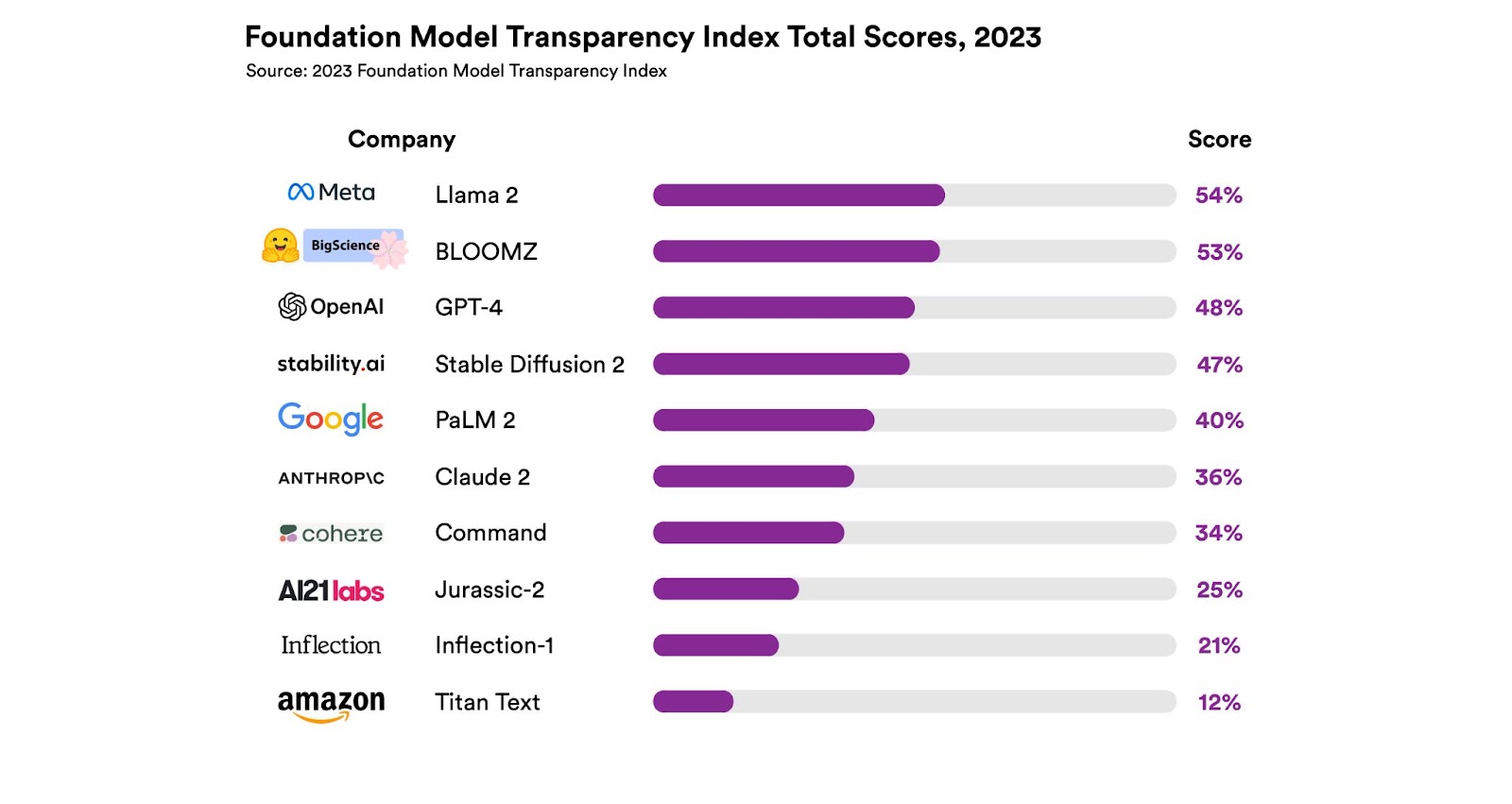
The Foundation Model (LLM) Transparency Index

A new index compiled by the Stanford University Center for Research on Foundation Models (CRFM) rates the transparency of 10 foundation model companies and finds them lacking. The best, Meta’s Llama 2, only scores 54% across 100 different aspects of transparency. As LLMs become more widespread and embedded into our lives, their transparency includes the computational resources, data, and labour used to build foundation models, the specifics of their architectures and their downstream use. You can read about The Foundation Model Transparency Index here. #LLM


Tuesday, October 17, 2023

CBR and Large Language Models Report on arXiv

 I've just published a report titled A Case-Based Persistent Memory for a Large Language Model on arXiv. The report explores Case-based reasoning (CBR) as a methodology for problem-solving that can use any appropriate computational technique. This report argues that CBR researchers have somewhat overlooked recent developments in deep learning and large language models (LLMs). The underlying technical developments that have enabled the recent breakthroughs in AI have strong synergies with CBR and could be used to provide a persistent memory for LLMs to make progress towards Artificial General Intelligence.

https://doi.org/10.48550/arXiv.2310.08842


Monday, May 8, 2023

What I'm reading: Sparks of AGI

Today I'm introducing a new feature of this blog. Every week I will highlight something I've read in the previous week that may interest readers of this blog. These will vary from books to academic research papers, online articles, to newspaper stories. There will always be a brief discussion about why the recommendation is interesting. 

Sparks of AGI paper
Let's start "what I'm reading" with a recently published paper from Microsoft Research titled: "Sparks of Artificial General Intelligence: Early experiments with GPT-4" by Sébastien Bubeck et al. The title explains why I find the paper exciting, but its strength lies in the methodology the researchers use to evaluate the performance of GPT-4. You needn't be a computer scientist or ML specialist to understand this paper. The paper is summarised by the authors in this manner: 

"We demonstrate that, beyond its mastery of language, GPT-4 can solve novel and difficult tasks that span mathematics, coding, vision, medicine, law, psychology and more, without needing any special prompting. Moreover, in all of these tasks, GPT-4's performance is strikingly close to human-level performance, and often vastly surpasses prior models such as ChatGPT. Given the breadth and depth of GPT-4's capabilities, we believe that it could reasonably be viewed as an early (yet still incomplete) version of an artificial general intelligence (AGI) system."

That really sums up why this paper is worth a read. If you are impressed by ChatGPT, you haven't seen anything yet!

Saturday, May 6, 2023

ChatGPT reviews my predicitions for AI made in 2012

My book, The Universal Machine, for which this blog was initially created, is partly about AI.  All of the history of computing is, from Ada Lovelace, through Turing to the present day.  The last two chapters of the book deal specifically with AI and make some predicitions.  I did not anticipate ChatGPT and the rapid rise of generative AI.  However, I thought "why not ask ChatGPT how prophetic my book was given a decade has passed since its initial publication".  Here is part of my conversation with ChatGPT:

Ian: Would you agree that in light of recent developments in AI, the book, The Universal Machine, was prescient.

ChatGPT: As an AI language model, I do not hold opinions or beliefs, but I can provide information on recent developments in AI and their relevance to Ian Watson's book "The Universal Machine".

Since the publication of the book in 2012, there have been significant developments in AI, including breakthroughs in deep learning and reinforcement learning algorithms, the emergence of new AI applications in areas such as natural language processing and computer vision, and the development of AI-powered autonomous systems in industries such as transportation and manufacturing.

In light of these recent developments, it can be argued that "The Universal Machine" was prescient in its analysis of the potential benefits and risks of AI.  For example, the book highlights the potential for job displacement and the need for new models of education and training to prepare workers for a changing job market, an issue that has become increasingly relevant in recent years.

Moreover, the book's discussion of the risks associated with autonomous weapons and the need for ethical guidelines for AI research and development are topics that have gained significant attention in recent years, with many experts and organizations calling for greater oversight and regulation of AI technologies.

Overall, while the field of AI continues to evolve rapidly, "The Universal Machine" provides valuable insights into the history and future of computing and AI, and remains a relevant and insightful read for anyone interested in understanding the impact of these technologies on society.

Well, I can't disagree with that!

Tuesday, May 2, 2023

AI can read your thoughts!

A story published in the Guardian is fascinating. Researchers at The University of Texas, Austin using LLMs (like ChatGPT), have been able to reconstruct stories from fMRI scans of peoples' brains. This has enormous potential benefits for people suffering from strokes and other neural-cognitive issues. But ethically, it's a potential minefield. Imagine if China could read the thoughts of its people? 


Blog reawakening

 This blog is coming back to life. I shut it down at the end of 2020 when I retired for health reasons. I report that my health is much better (though not perfect) now. However, since 2022 with the advent of ChatGPT and AI being in the news constantly, it seems timely to revive this blog. I've been working in AI since starting my MSc degree in 1985, so to leave the field just as it finally becomes significant seems crazy. This blog will therefore concentrate on the history of computing, focusing now on AI and its potential impact. That is what my book The Universal Machine does after all.