The ebook reader market is about to get a whole lot more competitive. A German company is about to release an ebook reader called the 'txtr beagle that will sell for around $15.00. The Guardian has recently done a review of the beagle and you can visit the company's website and register your interest. It's a little smaller and lighter than a Kindle (but much cheaper), runs for a year on 2 AAA batteries, but can only store 5 books at a time - how many books do you read at once?
There is one catch though. You'll not actually be able to buy a beagle in a store. It will only be available as an add-on or sweetener to your mobile phone contract. However, it does show that there may be a market for virtually free ebook readers in the future. After all Amazon makes a profit from the books they sell, not the Kindles you read them on.
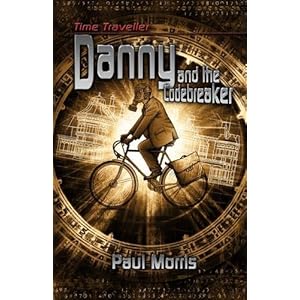
As Christmas approaches perhaps you want to Turing theme your Christmas gifts. A new childrens book, by Paul Morris, has a Turing connection: "Time Traveller Danny and the Codebreaker." The book, which is part of the Time Traveller Kids series for 7 to 12 year olds, tells the story of Danny who goes back in time and meets Alan Turing. Paul carried out background research for the book using the archives at Sherborne School where Alan was a student from 1926 to 1931. Paul also has a family connection with Turing because his father, then a clerk in a Manchester firm of solicitors, witnessed the signing of Turing’s will in February 1954.
Thanks to The Alan Turing Year for this information.
My colleague Bob Doran has recently returned from a trip to England where he visited Bletchley Park. He writes: I finally got to visit the displays at Bletchley Park. The biggest thrill was seeing the bombe replica in operation. Here it is being explained to a tour group:
Actually, it wasn’t working correctly but you could still get some idea of the noise that it made:
But the biggest surprise was learning that there was a bombe named Auckland. This is described with the text:
They had the actual sign for the Dunedin machine (this has been digitally enhanced):
All in all, an interesting experience to recommend.
With the US Presidential elections only a couple of days away it's time to talk politics. I'm not going to endorse either candidate, though if you know me at all you'll know whom I prefer. I live in New Zealand and obviously can't vote in US elections, but nonetheless the outcome will effect me, just as it will effect the entire world. The hactivist group Anonymous has recently released a video saying that they are watching Karl Rove, previously a senior advisor to George W. Bush, and will release any information that suggests he is trying to steal the election for the Republican party. Remember the "hanging chads" in the 2000 Presidential election that Al Gore lost by just a few hundred votes. Some commentators and bloggers are claiming that the right wing is calling the election "too close to call" to soften people up for a surprise win by Romney when they rig the ballot.
 |
| Konrad Zuse |
I picked up this story on Twitter from @AlanTuringYear - basically Heinz Billing, of the Max Planck Institute for Physics wrote in his memoirs that a group of British scientists from the National Physical Laboratory in London interrogated German scientists after WWII. Thus, Alan Turing, who was one of the British scientists ,would have met the German computer pioneer Konrad Zuse. Evidence for and against this meeting is described by Herbert Bruderer, of the Swiss Federal Institute of Technology Zurich, in a paper called Did Alan Turing interrogate Konrad Zuse in Göttingen in 1947?
If they did meet it would have been fascinating for both men. Zuse had independently invented a digital computer, the Z1, in Nazi Germany and after the war he founded a computer company that was eventually bought by Siemens. He also wrote a book, Computing Space, that presents the idea that the universe may actually be a digital construct running in the memory of a grid of computers.
You can find out more about this remarkable man in The Universal Machine.
I recently read a popular science book called "The Information: A History, A Theory, A Flood" by James Gleick. The book is basically a biography of Claude Shannon and is about information theory. It covers, what is quite a challenging subject, in a very approachable way; giving examples from African talking drums to modern digital communication. Other people also feature such as: Robert Caudrey, the compiler of the first English dictionary; Samuel Morse, the inventor of the eponymous code, and people more familiar to this blog, Charles Babbage, Ada Lovelace and of course Alan Turing.
I really enjoyed this book - 5 stars.
When Alan Turing looked at some sunflowers in his garden in Manchester he thought he saw a pattern he recognised in the spiral of seeds in the flowers' heads - the Fibonacci sequence, where each number is the sum of the previous two. Turing died before he could test his theory. As part of the celebrations around Turing's centenary hundreds of volunteers grew sunflowers as part of a project led by Manchester's Museum of Science and Industry. Data from 557 sunflowers from seven countries was collected for the Turing's Sunflowers project. It showed 82% of the flowers conformed to the mathematical Fibonacci sequence.
The BBC reports that Professor Jonathan Swinton, a computational biologist, said: "It's the most comprehensive information we have so far on Fibonacci numbers in sunflowers and we have proved what Alan Turing observed when he looked at a few sunflowers in his own garden in Wilmslow. Now we need to work together with biologists to understand the wider implications of different number patterns for plant growth."