The Loebner Prize in Artificial Intelligence is an annual Turing Test competition for chat bots. The Turing Test was devised by Alan Turing and is passed by a computer that cannot be distinguished in conversation from a person. So far no chat bot has won the Grand Prize of $100,000 and a gold medal, but each year a prize of $4,000 and a bronze medal is awarded to the best chat bot. Cleverbot is considered one of the best chat bots which you can try out below.
Part of the Analytical Engine in the London Science Museum
Plan 28 - is an ambitious project to build Charles Babbage's Analytical Engine - the world's first mechanical computer. Babbage never built the Analytical Engine during his life and many doubted that it would work. However, since Doran Swade's successful project at the Science museum to build a replica of Babbage's Difference Engine No.2, which does work, many people believe Babbage's Analytical Engine would also work. The Analytical Engine would not be a giant mechanical calculator like the Difference Engine - it's a programmable computer. It has a mechanical memory, called the Store. a central processing unit, called the Mill, andcan be programmed using punch cards for input and it can print out its results. It conceptual architecture is essentially the same as a modern digital computer. It would be the ultimate steam punk fantasy made real! For more information visit http://plan28.org
I recently came across a documentary called "Dangerous Knowledge" that looks at four brilliant mathematicians – Georg Cantor, Ludwig Boltzmann, Kurt Gödel and Alan Turing – whose genius has profoundly affected us, but who tragically all committed suicide.
I was watching some TED Talks last night and came across Ian Ritchie and his talk "The day I turned down Tim Berners-Lee." It's an entertaining short talk on the development of hypertext and the web. Well worth a watch. If you've not come across TED talks you're in for a treat, but be prepared for some late nights. I can't stop watching them into the we small hours.
Incidentally in 1992 Tim Berners-Lee's paper on the WWW was turned down from the Hypertext conference.
It's been a few days now since iOS 5 was released so probably a good time to do a quick review (note this isn't an iPhone 4S review as they aren't on sale in NZ yet). As has been mentioned elsewhere the upgrade process wasn't a complete success. Like many others I had to try about 20 times to get the upgrade process to complete on my iPhone which remained bricked for half the day. Upgrading the iPad was no problem and the move to iCloud on my Macs went fine. As the number of iOS devices continues to increase (there are now over 200 million) Apple should take note and seriously consider rolling these updates out incrementally in the future to reduce the load on their servers. I am left with one problem, Pages on my iPad uploaded documents to iCloud, or at least I though it did. Something went wrong, presumably because of server overload, and my documents are now neither on iCloud or on any of my iOS devices. As you can see in the photo ,most exist in limbo with a download status bar that never changes. I'm not the only person with this problem as I discovered on the Apple support forums. So far Apple haven't suggested a solution. I suspect they are lost and gone for ever. Fortunately I had the files backed up elsewhere but I'm sure there are some people who have lost important data. Apple FAIL. Now onto the positive stuff. The Notification centre is a big improvement and beautifully customisable, just about perfect. Photo Stream is, as Jobs would have said, magic. This is a feature I've imagined for years - a camera that automatically syncs itself into the cloud and to your other devices - perfect. A small note of caution though; if you're out and about you might want to be cautious if you're taking any risque shots as these will appear on the family computer if Photo Stream is enabled and you enter a wifi zone. The new camera app is an improvement. being able to crop, rotate, fix red eye and enhance on the iPhone is useful. I'm now not so sure I'll use Camera+ anymore, which was my camera app of choice. The Reminders app is useful, but it's a bit limiting that locations can only be selected from Contacts. I had to add my local supermarket as a Contact so I get Reminders when I go there. Integration with the Google Map app would have been more useful. Newsstand would be useful if New Zealand had any content for it. the same still applies to the iBook store, which after years still has no paid content, just free out of copyright stuff. Come on Apple, how hard can it be to open the iBook store in NZ.The new iMessage service for iOS to iOS device is great and will keep my monthly bills down. Being able to wirelessly sync and even being able to be totally PC free and back up to iCloud should make the iPad practical as some people's only computing device now. There are lots of other small changes, tweaks and additions, which all in all result in an excellent OS. I do have one small worry though that iOS 5.0 might be suffering from feature bloat. It has very many more features and options than iOS 3.0 had. Now for geeks like me options are good, but Apple typically adheres to the less is more philosophy and for many people too much choice and too many options just make the device more intimidating. A great example is the vibration alerts on the iPhone. in iOS 5 you can set custom vibrations to particular types of alert and for different people. 5 different vibration patterns are provide and if that isn't enough a nifty vibration design application is built. Come on, really, does anyone need to make their own customised vibrations! If you're wondering if it's worth upgrading, I'd say definitely yes. Everything seems to be running a little bit faster on an iPhone 4 and all is just fine on the iPad 2. Backup all your documents before you connect with iCloud though. Apple (if you're reading this) you seriously need to fix the iCloud/Pages documents in limbo issue. If you can't then compensate people (iTunes credit perhaps). Loosing people's data is unforgivable. I'm also a little concerned about the future of the MobileMe iDisk, which you say will be discontinued in June 30, 2012. iDisk with it's 20GB storage for any file type I find very useful as do many others on the forums. So far iCloud is not a replacement for it and currently it doesn't even automatically sync Pages, Keynote or Numbers documents from OS X. You've got 9 months, plenty of time to come up with an elegant solution for syncing all my data between my OS X and my iOS devices.
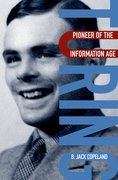
There will be a free public lecture by Professor Jack Copeland called "Alan Turing and the Secret Cyphers: Breaking the German Codes at Bletchley Park" on Thursday Nov 3rd at 5.30pm at University of Auckland Conference Centre, 22 Symonds St. Auckland, Building/room 423-342 (click here for a Google Map) . Jack Copeland is Professor of Philosophy and Director of the Turing Archive for the History of Computingat the University of Canterbury. His publications include the books The Essential Turing; Alan Turing's Automatic Computing Engine; Colossus: The Secrets of Bletchley Park's Codebreaking Computers; and more than 100 articles on the philosophy and history of computing, the philosophy of mind, and philosophical logic. It is now widely accepted that Alan Turing was one of the most important founders of both theoretical and practical computing, although he died in 1954 just when the field of computing was getting underway. After his fundamental work on the Theory of Computing, in 1939 Turing was recruited for the effort to decipher enemy codes at Bletchley Park. He disappeared from the public record and it was only many years later that it was widely known what he had accomplished. Turing initially worked on cracking the German “Enigma” codes which involved his devising electro-mechanical special-purpose computing machines known as “bombes.” The story of the Enigma cipher machine and its defeat by the Bletchley Park code-breakers has astounded the world. This lecture also describes Bletchley's success against a later, more advanced German cipher machine that the British codenamed Tunny. Unlike Enigma, which dated from 1923 and was marketed openly throughout Europe, the ultra-secret Tunny was created by scientists of Hitler's Third Reich for use by Hitler and his generals. Central to the Bletchley attack on Tunny was Colossus, the world's first large-scale electronic digital computer.