Here is a video that explains how Alan Turing and the code breakers at Bletchley Park cracked the German Enigma machine during WWII.

Showing posts with label Enigma. Show all posts
Showing posts with label Enigma. Show all posts
Monday, January 21, 2013

Friday, June 22, 2012
#Turing apps for your iPhone or iPad
Tomorrow on the centenary of Alan Turing's birth why not impress your friends with some apps for your iPhone or iPad that reflect Turing's genius. The first is an Enigma Machine emulator called MyEnigma. You can select between different version of the machine: Enigma I, M3 and M4, Railway, G-312, or Swiss-K, and set them up just as you would a real Enigma: choose rotors, configure them, and use the plugboard to switch letters. If a friend has MyEnigma and both are set to the same settings then you can encrypt and decrypt messages just as with a real Enigma machine. You can also challenge yourself to see if you can crack the Enigma code as Alan Turing did in WWII (sorry there isn't an iOS app for his Bombe). As you can see from the screen shots MyEnigma looks quite realistic.

The second iOS app that is Turing related is the Turing Machine Simulator that allows you write programs for a Turing Machine, execute them and analyze the execution step by step. The app comes with example Turing programs to play with.

Of course if you own an iPhone 4S then you can see if Siri can pass the Turing Test. Try asking it, "Siri, would you like to take the Turing Test?"
Update: I came across this article about iOS Turing apps a couple of days after Turing's centenary.

The second iOS app that is Turing related is the Turing Machine Simulator that allows you write programs for a Turing Machine, execute them and analyze the execution step by step. The app comes with example Turing programs to play with.
Update: I came across this article about iOS Turing apps a couple of days after Turing's centenary.
Friday, June 8, 2012
The #Turing Century - build your own Enigma

Thursday, December 15, 2011
Google make big donation to Bletchley Park Trust
 |
| A dilapidated WWII hut at Bletchley Park |
As you can see from the photo I took at Bletchley earlier in the year there is plenty of work needed to restore and maintain the old WWII huts were Alan Turing and others broke the Nazi Enigma & Lorenz codes. You can make a donation by following this link:
http://www.bletchleypark.org/content/contact/donation/support.rhtm
Saturday, November 5, 2011
Code-Breakers: Bletchley Park's Lost Heroes
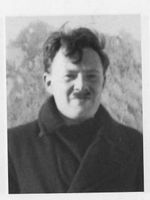 |
| Bill Tutte |
This documentary is about cracking the German High Command's Lorenz machine cypher or "Tunny" as the Brits called it. Unlike Enigma, which was invented in the 1920s and sold commercially (yes you could buy an Enigma machine before WW II and several were in use in England), Lorenz was state-of-the-art. It operated on telex transmissions rather than morse radio and it's operation was seamless; the sender typed in the message, their Lorenz machine encrypted it and the receiver's Lorenz machine decrypted it, all without any human intervention. The Allies had never seen a Lorenz machine and had to infer how it worked.
This remarkable feat was done by a young mathematician called Bill Tutte. Once the logical structure of the Lorenz machine was deduced Turing and Max Newman set about cracking the cypher. Newman designed an electro-mechanical machine nicknamed "Heath Robinson" to automate the laborious process known as Turingery. Like the cartoonists fabulously complex contraptions Robinson was prone to failure. A young electrical engineer called Tommy Flowers who worked at the Post Office Research Station designed an electronic replacement called Colossus - this was the worlds first electronic computer. By the end of the war there were 10 Colossus computers at Bletchley Park and the Allies were routinely reading all of the German High Commands telex traffic - Hitler's direct commands to his generals!
So if you've never heard of Bill Tutte, the Lorenz cypher, Tunny, Max Newman, Tommy Flowers or Colossus this excellent documentary will open a whole new chapter in WW II code-breaking for you. The documentary is available to watch on the BBC's website if you live in the UK. It's also available to download (illegally) from the usual bit-torrent search engines.
Sunday, October 16, 2011
Public Lecture - Alan Turing and the Secret Cyphers

Jack Copeland is Professor of Philosophy and Director of the Turing Archive for the History of Computing at the University of Canterbury. His publications include the books The Essential Turing; Alan Turing's Automatic Computing Engine; Colossus: The Secrets of Bletchley Park's Codebreaking Computers; and more than 100 articles on the philosophy and history of computing, the philosophy of mind, and philosophical logic.
It is now widely accepted that Alan Turing was one of the most important founders of both theoretical and practical computing, although he died in 1954 just when the field of computing was getting underway. After his fundamental work on the Theory of Computing, in 1939 Turing was recruited for the effort to decipher enemy codes at Bletchley Park. He disappeared from the public record and it was only many years later that it was widely known what he had accomplished. Turing initially worked on cracking the German “Enigma” codes which involved his devising electro-mechanical special-purpose computing machines known as “bombes.”
The story of the Enigma cipher machine and its defeat by the Bletchley Park code-breakers has astounded the world. This lecture also describes Bletchley's success against a later, more advanced German cipher machine that the British codenamed Tunny. Unlike Enigma, which dated from 1923 and was marketed openly throughout Europe, the ultra-secret Tunny was created by scientists of Hitler's Third Reich for use by Hitler and his generals. Central to the Bletchley attack on Tunny was Colossus, the world's first large-scale electronic digital computer.
Friday, April 29, 2011
Enigma
Last night I watched the 2001 movie Enigma. An entertaining WWII spy movie about Bletchley Park and the Enigma code. Unfortunately although a lot of factual details were correct, particularly with regard to the way the Enigma code was cracked using cribs and Bombe machines, the lead character, based on Alan Turing was totally wrong. They cast him as a working class heterosexual Mancunian; whereas of course Turing was a middle class southerner who was very gay. I found the experience of watching the film quite frustrating. Why did they feel the need to rewrite Turing in this way?
Subscribe to:
Posts (Atom)