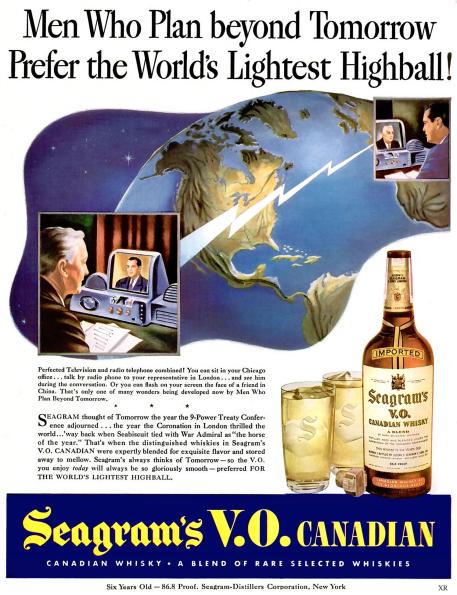
Predicting the future is hard - flying cars, hotels on the moon, that kinda thing. I know, I approached the final two chapters of The Universal Machine, which look at how computing will be in the future, with more trepidation than the historical section of the book. My colleague, Bob Doran, came across this web article that features a series of advertisements by Seagrams Whiskey from the 1940's. Each presents a vision of the future showcasing a particular technology. Some are fanciful, but the wall hung flatscreen TVs in a sports bar are spot on.
Sometimes this blog looks at possible futures for computing and they don't get much more radical than this. The 2045 Strategic Social Initiative is planning to create avatars into which we'll transfer our consciousnesses enabling us to become "neo-humans." SmartPlanet features an article on this called, How artificial intelligence will shape our lives and you can watch a big budget trailer for the project below.
Whilst researching The Universal Machine I read Michio Kaku's Physics of the Future: How Science Will Shape Human Destiny and Our Daily Lives by the Year 2100. I'm not usually a big fan of futurology; for example, Ray Kurzweil's pronouncements I find ludicrous. However, I really enjoyed Kaku's book and agree with most of his predictions. I like the way he divides his predictions into three categories: the near, middle and far future; and that he uses this framework to provide a level of certainty for the predictions. We can be certain of near future predictions, like driverless cars, because they are already in the research labs and are be tested on the roads. We can be reasonably certain of the middle future predictions because they represent reasonable progress from near future developments. However, we can't be very sure of far future predictions (about 100 years out) because we do not know what scientific breakthroughs there will be in the meantime. Nobody in 1910 predicted the Internet. The last two chapters of The Universal Machine deal with the future, but unlike Physics of the Future, I restrict myself to the impact of the computer, whereas Kaku's book is more wide ranging. I highly recommend this book.