Showing posts with label Science Museum. Show all posts

Tuesday, June 19, 2012

Codebreaker – Alan #Turing's life and legacy

This thursday Codebreaker a special exhibition opens at the London Science Museum to celebrate the centenary of the birth of Alan Turing on June 23.  The exhibition runs until the end of July, so perhaps if you're going to London for the Olympics you could pay a visit. The exhibition covers the full range of Turing's accomplishments, from WWII codebreaking, through the development of early computers to artificial intelligence and his pioneering work on biological morphogenesis. The highlight of the exhibition is the Pilot Ace computer which Turing designed. In it's day (1950) it was the fastest computer in the world. The BBC has a short video describing the exhibition.

Saturday, December 24, 2011

Other half of Babbage's brain found!
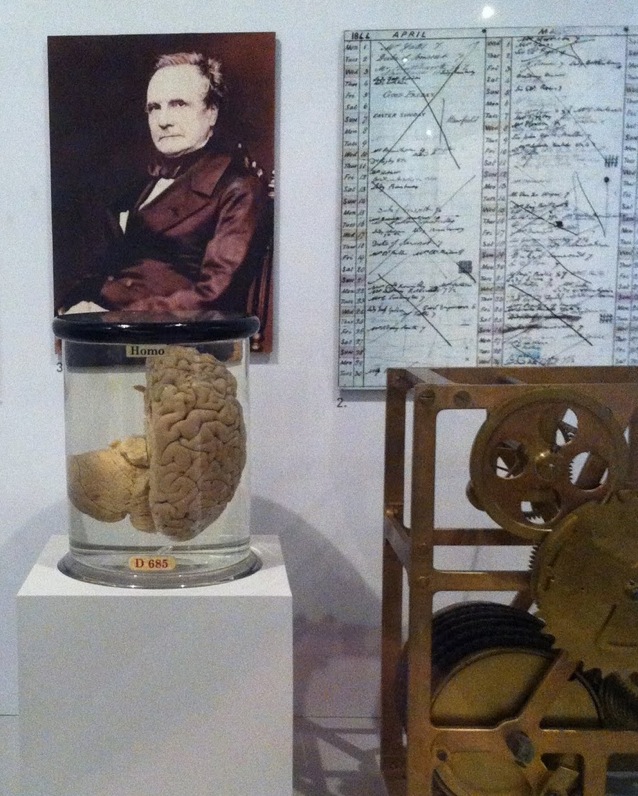
Charles Babbage & half his brain
If you follow this blog you'll know that earlier in the year I visited the London Science Museum to see the replica of Charles Babbage's Difference Engine No.2. It was fascinating, but I was surprised to see that they had half of Babbage's brain pickled in a jar on display. Why I wondered did they half half of his brain? It didn't seem to serve any educational purpose. Also, where was the other half? This continued to occasionally trouble me. The mystery has been solved thanks to Wikipedia; the other half is preserved at the Hunterian Museum in the Royal College of Surgeons in London. I don't know if it's on display there (perhaps somebody can tell us). I haven't visited the Hunterian Museum, but I did visit the Surgeons' Hall Museum in Edinburgh in August, which was fascinating. A little macabre and ghoulish but very interesting.

Sunday, December 18, 2011

Google sponsors Turing centenary exhibition

Good news. Google is supporting two exhibitions exploring the history of computing at the Science Museum in London. The first will celebrate the centenary of the birth of Alan Turing, the English mathematician and WWII codebreaker who is considered the “father” of computing. His theoretical idea, the Turing Machine, is the foundation of the modern computer. The exhibition is intended to inspire a new generation of scientists and innovators and will showcase how the legacy of Turing's universal machine is shaping our future.
My book should be the perfect companion to the exhibition.
The second exhibition in 2014 will showcase communications technology.