Whilst researching material for my book I came across a website and blog called allaboutSteveJobs.com. If you have an interest in Steve Jobs and are looking for lots of background material this is the site for you. There are maps of key places in Jobs' life, photos, video, biographical information and lots more.
I'm about half way through Steve Jobs' official biography and will write another review soon

Thursday, November 3, 2011

Tuesday, November 1, 2011
Oh wow, oh wow, oh wow
Steve Jobs' sister, the novelist and academic Mona Simpson, gave this moving eulogy on Oct. 16 at his memorial service at the Memorial Church of Stanford University. It was printed in the New York Times on Oct 30.
Friday, October 28, 2011
Will Facebook & Twitter fade away?

The reader comments section was full of the predictable "who'd listen to AOL's digital prophet" jokes and comments by people who say Facebook and Twitter suck and comments that say the converse. I think, as becomes obvious if you read just a few of the comments, that people use Facebook and Twitter in different ways and for different reasons. For some Facebook is a place for online communication between people they know and meet f2f. For others a way of keeping in touch with similar people whom they've never met and never will. For some Twitter is a way of keeping up with the minutia of what friends are doing, for some it's for following their idols (e.g., Steven Fry). For me Twitter is about getting a weird interesting newsfeed suggested by a group of people most of whom I don't know but who seem to have similar interests. It's rather random hence its benefit - it surprises often. Facebook I use just to keep in touch with real friends (I have about 35).
There's no single use for any of these services and that's their strength. I don't see them going away anytime soon. MySpace is declining because it never really was about friends. It didn't really provide a social network; it was more an ego thing: "look at me," "listen to my band," "watch my fab video," "aren't I cool and wonderful." Great for bands to publicise themselves to their fans, but not so useful to keep in touch with a good friend who has moved to a different city. Facebook and Twitter if you want to use them that way excel at this.
Thursday, October 27, 2011
Steve Jobs by Walter Isaacson - review pt.1
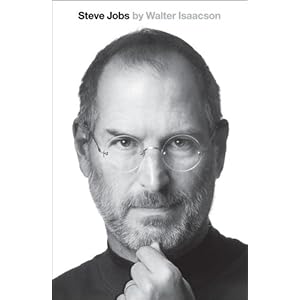 |
| Steve Jobs by Walter Isaacson |
First thing is that Walter Isaacson, who is apparently an eminent biographer, having written biographies of Einstein and Benjamin Franklin before, is not a great writer. The book is perfectly readable, but rather pedestrian, a bit like a History Channel show, very worthy and sincere. So, onto the content and Jobs' early life. The book hasn't really revealed anything startlingly new. There's plenty of detail, but at over 650 pages long you'd expect more detail than the other shorter unofficial biographies. We get a lot of detail on Jobs interest in Zen and other Eastern religions and his LSD use and experiments with weird diets: just fruit, just apples, no mucous products...But I'm not sure this tells us anything.
There's an attempt to make us believe that Jobs' interest in Zen and experiments with psychodelic drugs and strange diets was part of a quest for a better way of living that has now become part of Apple's DNA. I think there is a danger of reading too much into a young man's motives - it's not as if any of what Jobs was doing in the 1960s and early 70s was in anyway unsual. All the kids in the San Francisco area were into mediation, LSD, Bob Dylan and macro-biotic diets. Jobs was actually being entirely normal for his generation and locale - this was the epicenter of the hippie movement. Dropping out of Reed College after one semester, refusing to acknowledge he was the father of his girlfriend's child, going to India on the hippie trail, conning Woz out of a few thousand dollars on the Atari deal, not wearing shoes and all the rest can just as easily be attributed to a confused young man, unsure of what he wanted in life and sometimes shirking his responsibilities in a very immature way.
Isaacson could at least hint that perhaps Jobs was not always a visionary in pursuit of spiritual and aesthetic perfection, who occasionally fucked-up, but was instead just as confused as the rest of us. [Part 2 of the review is here]
Wednesday, October 26, 2011
John McCarthy AI pioneer dies

John McCarthy was 84.
Sunday, October 23, 2011
Will Apple own your living room?

 by Walter Isaacson, which has been rushed into print and is due to be published tomorrow, Jobs' biographer says: "He [Jobs] very much wanted to do for television sets what he had done for computers, music players, and phones: make them simple and elegant...I’d like to create an integrated television set that is completely easy to use,’ he told me. ‘It would be seamlessly synced with all of your devices and with iCloud.’ No longer would users have to fiddle with complex remotes for DVD players and cable channels. ‘It will have the simplest user interface you could imagine. I finally cracked it."
If you think about it Apple could easily make a TV; either the Apple Cinema Display, or the iMac make a reasonable TV chassis; the current Apple TV provides the streaming content, iOS the operating system and the iPod Touch, iPhone and iPad make excellent remote controls. Apple also now has the brand cachet to cross over easily into the consumer electronics market - would people rather have the latest Sony or LG TV or an Apple? Apple's key advantage would be in it's integration with iTunes and iCloud, its intuitive user interface and it's iOS remotes. With Siri you'd be able to say things like "record tomorrow's football game." and it would. By contrast a friend of mine recently bought an LG Internet connected TV and it's remote control is a nightmare of myriad small buttons - really horrible. Google's recent foray into TV, which wasn't successful was largely brought down by a clunky interface and a complicated remote control (read an extensive review from Engadget here).
I think the rumours are true, Apple will announce a TV set in 2012, partly because all the various components have fallen into place now: hardware, operating system, iCloud, remote control; but also for a more strategic reason. Microsoft gained preeminence in the 1980s and 1990s by putting a Windows PC on every desktop; Google came to the front by totally dominating web search; Apple plans to own your living room! They already have your music library with iTunes; Photo Stream and iCloud make managing your digital photos a brease; controlling your TV and movie viewing experience is the missing piece of the puzzle. Watch this space, your living room is about to become a battle ground.
Saturday, October 22, 2011
Turing - Pioneer of the Information Age
Turing - Pioneer of the Information Age
B. Jack Copeland
ISBN 978-0-19-963979-3
More information from the publisher here.
Subscribe to:
Posts (Atom)