 |
| Rotors from an Enigma Machine |

Friday, October 14, 2011
The Turing Centenary
If you have an interest in Alan Turing you may be interested in The Turing Centenary blog, which is counting down to the centenary of Turing's birth next year. Lots of interesting information on it.

Dennis Ritchie pioneering programmer dies
 |
| Dennis Ritchie |
Thursday, October 13, 2011
Leonardo DiCaprio tipped to play Alan Turing
 |
| Turing's Office at Bletchley Park |
Read the Guardian story here.
Wednesday, October 12, 2011
The History of Hacking - documentary
During research for my chapter on hacking I came across an interesting old Discovery Channel documentary called "The History of Hacking." It features, Captain Crunch, Steve Wozniak, and Kevin Mitnick.
Robot to carry 2012 Olympic torch
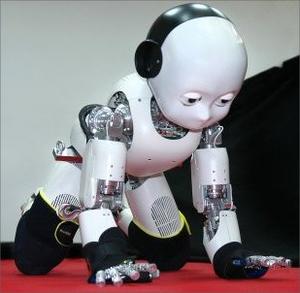 |
| The iCub Robot |
Tuesday, October 11, 2011
Review: The Facebook Effect: The Inside Story of the Company That Is Connecting the World

The Facebook Effect: The Inside Story of the Company That Is Connecting the World by David Kirkpatrick
My rating: 0 of 5 stars
Reading this as research for my book (http://universal-machine.blogspot.com/) - quite detailed so far and presents Zuckerberg in a favorable light .
View all my reviews
Open vs. closed
There's a piece in Slate magazine by Esther Dyson that puts forward the idea that Steve Jobs didn't like open systems because he knew that Apple could do better.
To an extent I agree but I think Apple was perceived as being closed for very different reasons. First, although Apple is not known for championing open systems it did develop WebKit and make it open source. WebKit is the core of Apple's Safari browser, Google's Chrome, the browser on the Kindle and Android. So that's quite a major contribution to the open source movement I'd say. I'm not sure if Apple is closed in the same sense as the opposite of open source. I see Apple's so called "walled garden" as being a way of ensuring that users don't get really crappy apps on their devices. Apple is vetting them for quality and since that costs $$s it takes a proportion of the apps sale price (zero if the app is free).
I think Jobs was all to well aware of the chaos that an unregulated market in software had caused in the Windows ecosystem and did not want that repeated on iOS devices. It's particularly important that your cell phone doesn't crash or contain spyware. I'm sorry but as more naive users buy computers they do need protecting from some fairly unpleasant people out there on the internet and that doesn't just mean anti-virus software. Somebody has to vet the applications people may be trying to install on their machines. Apple have taken it upon themselves to do that and it's not unreasonable that they get paid to do so. Remember that walled gardens were made to create a better micro-climate inside the garden than out.
"Openness is great, and a strategy I normally applaud: No single vendor is likely to be the best, so openness allows a broad range of suppliers to compete and differentiate so the best can emerge. The closed strategy makes sense only if you are the best. That is what Steve was."
To an extent I agree but I think Apple was perceived as being closed for very different reasons. First, although Apple is not known for championing open systems it did develop WebKit and make it open source. WebKit is the core of Apple's Safari browser, Google's Chrome, the browser on the Kindle and Android. So that's quite a major contribution to the open source movement I'd say. I'm not sure if Apple is closed in the same sense as the opposite of open source. I see Apple's so called "walled garden" as being a way of ensuring that users don't get really crappy apps on their devices. Apple is vetting them for quality and since that costs $$s it takes a proportion of the apps sale price (zero if the app is free).
I think Jobs was all to well aware of the chaos that an unregulated market in software had caused in the Windows ecosystem and did not want that repeated on iOS devices. It's particularly important that your cell phone doesn't crash or contain spyware. I'm sorry but as more naive users buy computers they do need protecting from some fairly unpleasant people out there on the internet and that doesn't just mean anti-virus software. Somebody has to vet the applications people may be trying to install on their machines. Apple have taken it upon themselves to do that and it's not unreasonable that they get paid to do so. Remember that walled gardens were made to create a better micro-climate inside the garden than out.
Subscribe to:
Posts (Atom)